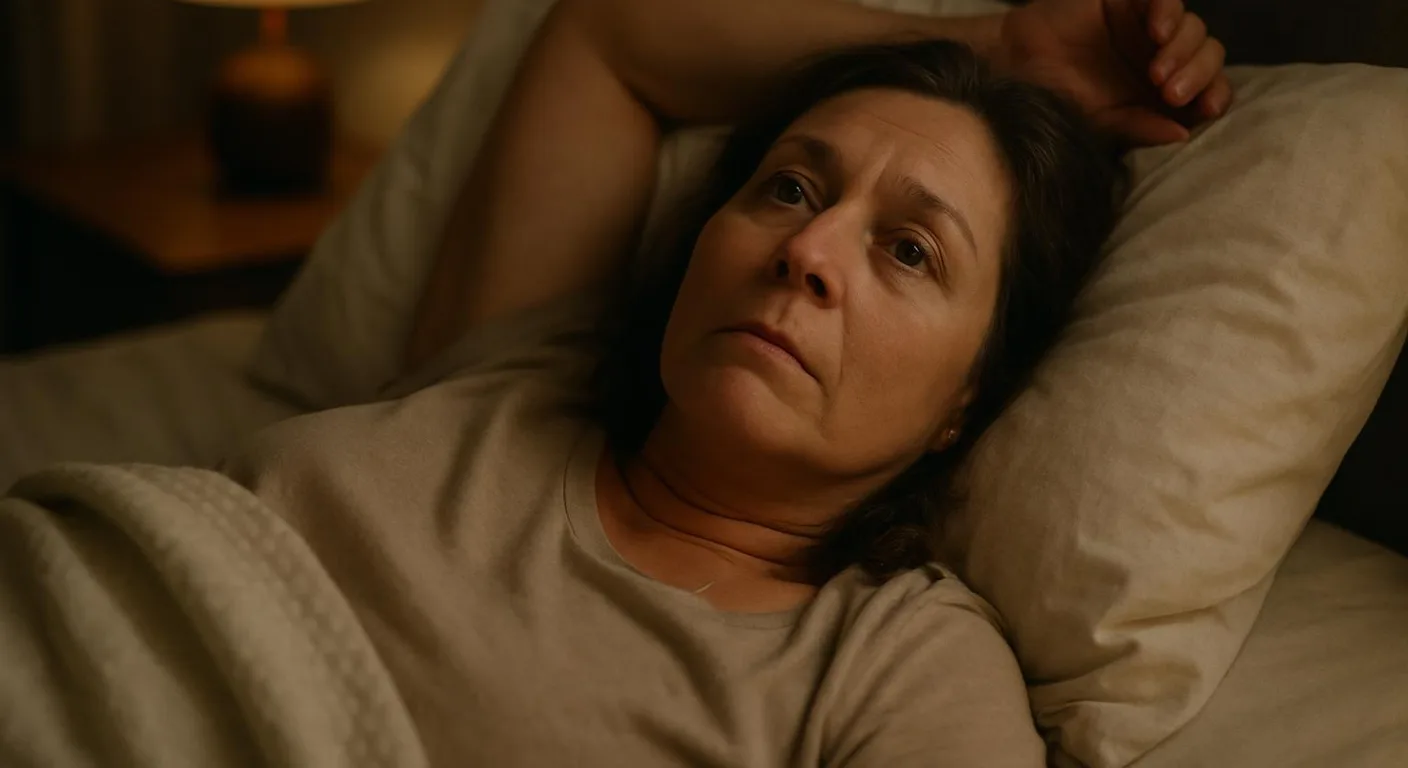
Why am I still waking up at 3am even though I am taking estrogen?
Hormone therapy is not one treatment with one effect. It is very good at some things and only patchily good at others, and sleep sits in the second group.
The clearest evidence comes from the Kronos Early Estrogen Prevention Study, which randomized 727 women aged 42 to 58, all within three years of their final period, to low-dose oral conjugated estrogens, transdermal estradiol or placebo, then followed them for four years. The vasomotor result was decisive. Moderate to severe hot flashes dropped from 44 percent at baseline to 7.4 percent on transdermal estradiol and 4.2 percent on oral estrogens, and night sweats fell from 35 percent to 5.3 percent and 4.7 percent. The insomnia result was not decisive. Insomnia decreased in every group including placebo, and the hormone arms beat placebo only at scattered time points: oral estrogens at 36 and 48 months, transdermal estradiol at 48 months (Santoro et al., 2017).
That is the whole point of this article. The same trial that nearly abolished night sweats barely moved insomnia.
Do estrogen and progesterone do different jobs in sleep?
Yes, and the split matters for anyone whose nights did not change.
Progesterone is metabolized into allopregnanolone, which acts as a positive allosteric modulator at the GABA-A receptor, the same receptor family sedative drugs act on. That is the mechanism behind progesterone's reputation as the calming half of hormone therapy. The mechanism is real. The human sleep evidence is narrower than the reputation.
A systematic review and meta-analysis pooled nine randomized controlled trials of micronized progesterone covering 388 participants, eight of those trials in postmenopausal women. Meta-analysis of four of those trials favored micronized progesterone for sleep onset latency (effect size 7.10, confidence interval 1.30 to 12.91) but showed no significant effect on total sleep time or on sleep efficiency (Nolan et al., 2021).
Sleep onset latency is how long it takes you to fall asleep. Total sleep time and sleep efficiency are the measures a 3am waking destroys. So the best-evidenced sleep benefit of the progesterone side of hormone therapy sits at the front of the night, not in the middle of it. The GABA side of this is unpacked further in why you cannot fall asleep in menopause.
Does it matter which progestogen my regimen uses, or whether it has one?
Regimens differ more than most women realize, and every difference is a prescribing decision, not a dial you should turn yourself.
A progestogen is included for endometrial safety, not for sleep. A Cochrane review found that unopposed estrogen probably increases the risk of endometrial hyperplasia at one year compared with placebo, at 22 to 43 events per 1,000 women against 5 per 1,000 (odds ratio 5.86, six randomized trials, 2,493 women, moderate-certainty evidence) (Kim et al., 2025). Women who have had a hysterectomy do not carry that risk, which is why estrogen-only regimens exist at all.
Which progestogen also varies. A 2026 narrative review of progestogen monotherapy notes that micronized progesterone specifically shows additional benefits for sleep quality, while the synthetic progestins are discussed in terms of bone protection rather than sleep (Thomas et al., 2026). A randomized trial of 100 Thai women at a single menopause clinic compared dydrogesterone with micronized progesterone, both alongside estradiol, and found sleep quality improved in both groups with no significant difference between them (p = 0.08). That trial had no placebo arm, so it cannot tell you how much of the improvement was the drug (Leeangkoonsathian et al., 2017).
None of that is a reason to change anything on your own. It is a reason to ask your prescriber what is in your regimen and why that is.
Can estrogen itself keep me awake at night?
Randomized trial evidence does not show hormone therapy causing insomnia. In the four-year KEEPS data, insomnia went down rather than up in both hormone arms. It simply did not go down reliably more than it did on placebo (Santoro et al., 2017).
What the evidence does show is that treating vasomotor symptoms and treating insomnia are two different results. A 2026 systematic review and meta-analysis of randomized trials in perimenopausal and postmenopausal women with chronic insomnia found that pharmacological treatments improved sleep quality scores but not insomnia severity scores, and that neither objective nor subjective total sleep time was changed by any treatment studied (Bruyneel et al., 2026).
So if the flashes stopped and the 3am waking did not, that is a documented pattern, not a sign that you are doing hormone therapy wrong. It usually means the waking has a driver hormones were never going to reach. If your sleep clearly and consistently worsened after a regimen started or changed, that is a conversation for the clinician who wrote it, not something to fix by adjusting a dose or moving a patch yourself.
Could sleep apnea be waking me at 3am instead of my hormones?
It is the possibility most worth taking seriously, and a woman already on hormone therapy is well placed to spot it, because the hormone-responsive explanations have already been treated.
Obstructive sleep apnea affects up to 23 percent of women and remains heavily underdiagnosed. Women with apnea are comparatively more likely to report insomnia and mood disturbance and less likely to report loud snoring or witnessed pauses in breathing, and current screening tools were built around the symptoms men present with. Apnea risk rises significantly after menopause, on top of chronological aging, and women who reach menopause earlier, naturally or through surgery, are more susceptible still (Dunietz et al., 2026). A separate 2026 review of diagnosis and treatment in women puts the share of affected women who remain undiagnosed at up to 75 percent, and notes that women more often present with daytime fatigue, insomnia, depression and anxiety than with the classic sleepiness and snoring (Bouloukaki et al., 2026).
Estrogen does not treat an obstructed airway. There is more on the overlap in why sleep gets worse in menopause.
What else wakes women at 3am that estrogen cannot touch?
Three things come up again and again, and none of them respond to a hormone prescription.
Low iron and restless legs. A 2026 JAMA review, covering adults in general rather than menopausal women specifically, reports that restless legs syndrome affects around 3 percent of US adults at a clinically significant level, is roughly twice as common in women as in men, and causes difficulty falling asleep, staying asleep and returning to sleep. Iron treatment is indicated when serum ferritin is at or below 100 ng/mL or transferrin saturation is under 20 percent, a far higher bar than most labs flag. The same review lists serotonergic antidepressants and centrally acting antihistamines such as diphenhydramine, the sedating ingredient in many over-the-counter sleep aids, among the drugs that make it worse (Winkelman and Wipper, 2026). Iron in midlife has its own moving parts, covered in can perimenopause cause low iron.
Thyroid. Night sweats and 3am waking both sit on the thyroid symptom list, which is why they get attributed to menopause by default. The overlap is worked through in night sweats and the thyroid connection.
Alcohol. An evening drink and a 3am waking are a familiar pair, and hormone therapy does nothing about it. See why alcohol hits harder in perimenopause.
What should I raise with my prescriber if HRT has not fixed my sleep?
Nothing below is a change to make. It is a list of things worth putting in front of the person who prescribes for you.
Ask about a sleep study. Particularly if you have daytime exhaustion, morning headaches, or a partner who has noticed you stop breathing. Apnea in women is missed partly because the standard questionnaires do not ask about the symptoms women actually report (Dunietz et al., 2026).
Ask for ferritin and transferrin saturation, not just hemoglobin. The restless legs treatment threshold sits at ferritin at or below 100 ng/mL, well above the level most labs call low (Winkelman and Wipper, 2026).
Ask for a medication review, including anything you buy over the counter for sleep.
Ask about a referral for CBT for insomnia. In a randomized pilot trial of 43 perimenopausal and postmenopausal women who met diagnostic criteria for insomnia disorder and had at least one nocturnal hot flash a night, a cognitive behavioral program adapted for menopausal insomnia cut Insomnia Severity Index scores by 10.2 points against 6.2 in the education control group (p = 0.007), and the night-time sleep improvement was still there at three months (Arentson-Lantz et al., 2026). The 2026 meta-analysis above concluded that non-pharmacological approaches, cognitive behavioral therapy for insomnia foremost, are the most robust first-line option for this group (Bruyneel et al., 2026).
Ask what is actually in your regimen. Which estrogen, which route, whether a progestogen is included and which one. Ask. Do not adjust.
My Perspective
I hear a version of this every week, and the tone is always the same, half embarrassed and half furious. She did the hard part. She found a prescriber who would actually prescribe, she sat through the appointments, she pays for it every month, and she is still lying there at 3:04am doing arithmetic about how many hours are left.
Here is the reframe I offer, and I think it is honest. Hormone therapy did not fail her. It did the job it has the strongest evidence for, the flashes and the sweats, and it left standing a second problem that was always going to need a second answer. Insomnia is not a hot flash you can feel. Once a body has spent two years learning that 3am is a time to be awake, it keeps the appointment even after the original reason is gone. That is why the treatment with the best evidence in this group is behavioral rather than pharmacological, and it is why the women who get their nights back are almost never the ones who kept fiddling with the hormones. They are the ones who went looking for what else was in the room.
A note from Marilyn: This is education, not medical advice, and nothing here is a reason to change, stop, add to or re-time a prescription. Hormone therapy decisions belong to you and the clinician who prescribes for you. If your 3am waking comes with snoring, gasping, morning headaches or daytime exhaustion, please ask about a sleep study. I am a nutrition specialist, not your physician.
The full picture of what falling estrogen does to sleep, metabolism and the stress axis is in Estrogen Left the Chat: Biohacking Menopause. If you want to work out which 3am mechanism is most likely yours, the complete map of causes sorts them one by one, and the free 60-second quiz will point you at your menopause type. Receipts will then show you, in your own data, whether anything you change is actually moving your nights.