Does menopause actually change your gut bacteria?
Less clearly than the wellness internet says. A 2026 systematic review and meta-analysis pooled 7 studies: 45 women with premature ovarian insufficiency, 1,222 postmenopausal women and 463 premenopausal controls. It found no significant difference in alpha diversity (p=0.990), in Bacteroidetes or Firmicutes abundance, or in the Bacteroidetes to Firmicutes ratio. The authors flagged very high heterogeneity between studies and limited control of confounders, and concluded that current evidence does not support consistent microbiome differences by estrogen status alone (Frontiers in Endocrinology, 2026). That does not mean nothing changes. It means "menopause wrecks your microbiome" is not a settled finding, and anyone selling that line is ahead of the data. What the data do support is narrower and more useful: the gut looks different in women whose metabolism has already tipped.
Why do gut studies in midlife women disagree so much?
Because the gut responds to a lot besides hormones. The 2026 meta-analysis reported heterogeneity between studies as high as 99 percent (I² 61-99%), which means the individual studies were measuring quite different things. A separate 2026 study of women with polyendocrine metabolic ovarian syndrome, a hormone-driven metabolic condition, found that after adjusting for age, body mass index and recent antibiotic use, the condition was not significantly associated with gut diversity. Host factors such as BMI and age explained more of the variation in bacterial communities than the ovarian condition did (Frontiers in Endocrinology, 2026). That was a different condition from menopause, so I would not stretch it too far, but the lesson transfers: body composition, age, medication and diet can swamp a hormonal signal. It is also why a single stool test cannot tell you much about your own hormones or your own insulin sensitivity.
Do gut bacteria track insulin resistance after menopause?
In one cross-sectional analysis, yes. Researchers studying Mexican women found that in postmenopausal women, gut microbial diversity decreased progressively as the number of metabolic syndrome components increased. Women with metabolic syndrome had more Lactobacillus, Roseburia and Escherichia/Shigella, and less Akkermansia and Christensenellaceae R-7. Their bacteria also showed altered carbohydrate, lipid and amino acid pathways, and serum alanine was higher as severity rose (BMC Microbiology, 2026). Two cautions matter. Cross-sectional means a snapshot, so it cannot tell you whether the bacteria caused the metabolic change or followed it. And Lactobacillus was enriched in the women with more metabolic disease, which is a good reason not to assume that any probiotic-sounding bacterium is protective.
How could gut bacteria push blood sugar up?
The leading proposal is inflammation. A 2026 narrative review of gut microbiota and metabolic syndrome in postmenopausal women describes a loss of beneficial bacteria such as Akkermansia muciniphila and Bifidobacterium, and a rise in lipopolysaccharide-producing microbes such as Proteobacteria and Escherichia coli. Lipopolysaccharide is a fragment of bacterial cell wall. When the gut barrier is more permeable, it can cross into the bloodstream (endotoxin translocation) and keep the immune system in a state of low-grade inflammation, which the review links to the components of metabolic syndrome, including insulin resistance (Minerva Endocrinology, 2026). This is a mechanism proposed from correlations, not a proven chain of events in every woman. If you want the barrier side in more depth, I cover it in Leaky Gut & Chronic Inflammation in Midlife Women.
Where does the estrobolome fit in?
The estrobolome is the set of gut bacteria that handle estrogen recycling, and it is the part of this story most people have already heard. I keep the enzyme chemistry in Estrobolome & Menopause: Why Your Gut is Key to Hormone Balance so this page can stay on blood sugar. The short version is that a 2025 review in the Journal of Menopausal Medicine describes how gut microbiota composition shifts through the menopause transition and how that affects estrogen regulation (Journal of Menopausal Medicine, 2025), and a 2024 bibliometric analysis shows research linking gut microbiota to insulin resistance has expanded steadily over two decades (Frontiers in Medicine, 2024). Those two bodies of work overlap, but nobody has yet shown that fixing the estrobolome alone fixes insulin resistance. Treat the connection as plausible and under active study, not as a proven loop.
What can you actually do that the evidence supports?
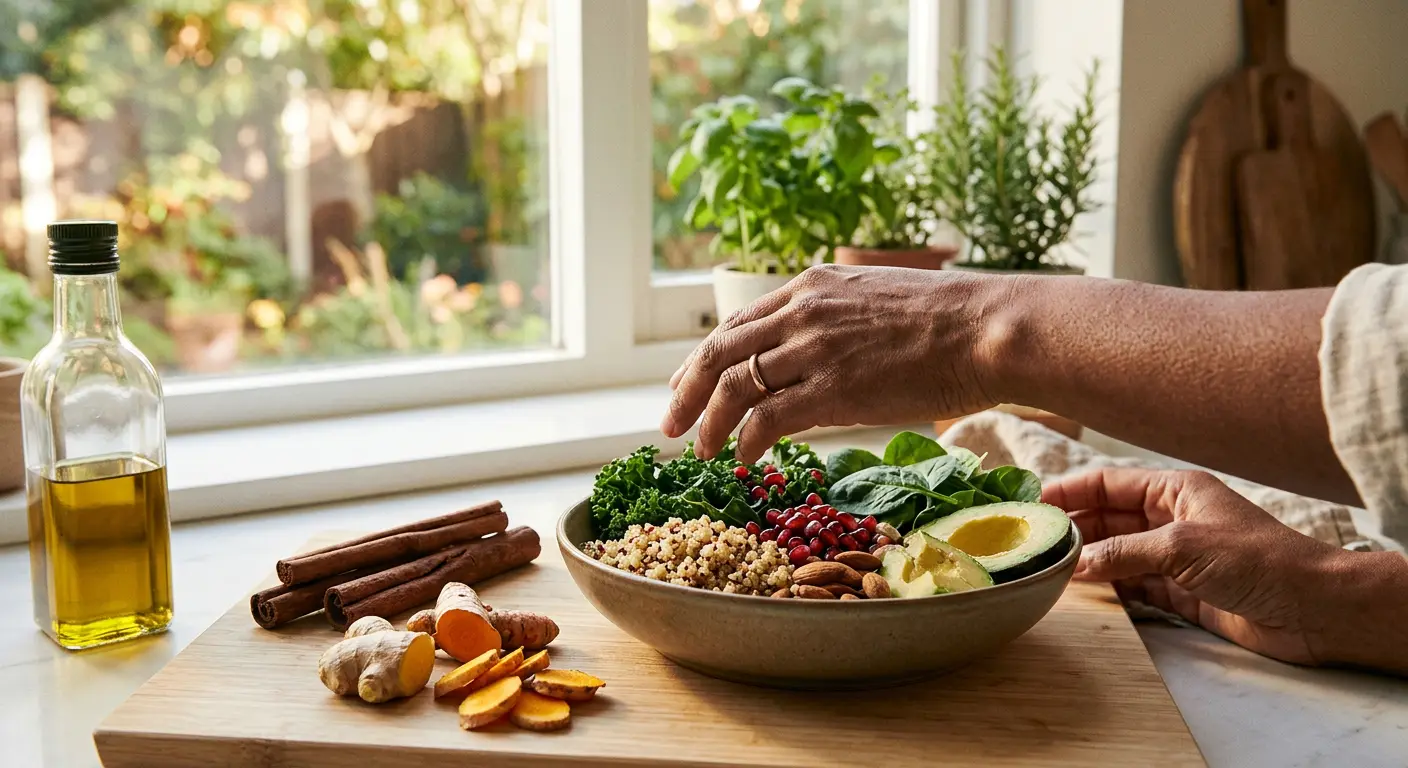
Aim at the pattern, not a product. The Minerva review points to the Mediterranean diet, rich in fiber, polyphenols and monounsaturated fat, as a dietary pattern shown to support gut microbiota, increase short-chain fatty acid production, reduce inflammation and improve metabolic homeostasis (Minerva Endocrinology, 2026). A 2026 narrative review of polyphenols in menopause concluded that polyphenol-focused eating could be a useful strategy for cardiometabolic changes, while noting that gut bacteria are needed to break many polyphenols down and that advice should ultimately be personalized (Nutrients, 2026). In practice that means a wide range of plants across the week: berries and leafy greens, olive oil, legumes and nuts, with fewer ultra-processed foods. One easy target is to count different plant foods rather than grams, and try to add one new one each week, such as a different bean or a new green. Cooked and cooled starches, such as potatoes or oats prepared ahead, and whole grains also add fiber. None of this is exotic, and none of it needs a supplement. For the broader eating framework see Insulin Resistance Menopause Diet Plan, and for food choices aimed at the gut itself see Unlock Your Gut: How to Improve Gut Health in Menopause.
Why won't gut-focused eating fix insulin resistance on its own?
Because the gut is one input among several. Estrogen has direct effects on how muscle and liver respond to insulin, and I walk through those in Insulin Resistance in Perimenopause: What's Really Happening?. Sleep is another: How Poor Sleep Worsens Insulin Resistance in Menopause, Independent of Diet shows why a perfect diet does not cancel a bad week of nights. Strength training and stress load matter too. The gut research is best read as a reason to eat for diversity while you address those bigger levers, not as a replacement for them. If you are unsure whether your blood sugar is actually a problem, ask your clinician for fasting glucose and HbA1c, and see Should You Use a Continuous Glucose Monitor in Menopause? before buying a sensor. A stool test sold online cannot answer the insulin question.
My Perspective
I like the gut story, and I distrust how confidently it gets told. When I read that meta-analysis, what struck me was how quickly "your microbiome changed at menopause" turns into a sales pitch when the pooled data do not show it. What the better studies show is that the gut looks different in women whose metabolism is already struggling, which is a reason to look after both together, not to chase a bacterial fix. I would rather give you a food pattern that costs almost nothing and is supported from several angles than promise that one probiotic will rescue your blood sugar. If your fasting numbers are creeping up, treat the gut as one lever, keep the others in view, and keep asking questions.
A note from Marilyn: This is education, not medical advice. Rising blood sugar, persistent digestive symptoms or a diagnosis of insulin resistance deserve proper evaluation by your own healthcare provider. I am a nutrition specialist, not your physician.
The wider picture of how estrogen reaches your gut, metabolism, sleep and mood at once is in Estrogen Left the Chat: Biohacking Menopause. If you are not sure which menopause pattern fits you, the free 60-second quiz is a good starting point, and Receipts can help you track how changes in what you eat line up with your own symptoms over time.
Frequently asked questions
Does menopause change gut bacteria?
The evidence is mixed. A 2026 meta-analysis of 7 studies, including 1,222 postmenopausal women, found no significant difference in gut diversity or in the main bacterial groups compared with premenopausal women, though the studies varied widely. Some individual studies do report shifts, so the honest answer is that it is not yet established.
Is gut diversity linked to insulin resistance in postmenopausal women?
In one 2026 cross-sectional study, gut microbial diversity in postmenopausal women fell progressively as the number of metabolic syndrome components rose. That is an association at one point in time, so it cannot show whether low diversity causes insulin resistance or results from it.
Can probiotics fix insulin resistance after menopause?
There is no good evidence from this research that they can. In a 2026 study of postmenopausal women, Lactobacillus was actually more abundant in those with metabolic syndrome, and Akkermansia was lower. Eating a varied, high-fiber, polyphenol-rich Mediterranean-style diet has better support than any single probiotic.
What is the best diet for gut health and blood sugar in menopause?
A Mediterranean-style pattern is the best supported: plenty of varied plants, legumes, nuts, olive oil, berries and leafy greens, with fewer ultra-processed foods. A 2026 review links it to more short-chain fatty acid production, less inflammation and better metabolic balance in postmenopausal women.