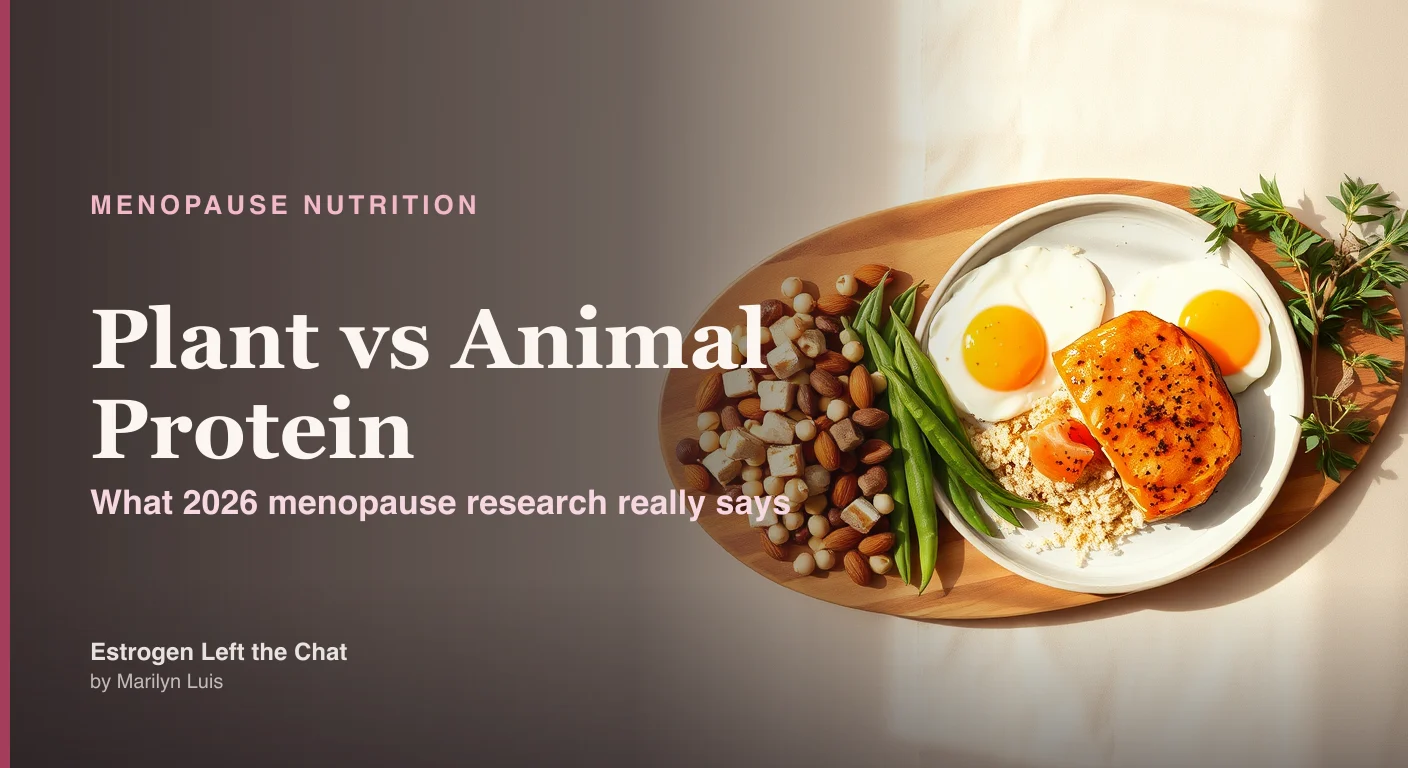
So let me do what the headlines won't: separate the real, useful finding from the "go vegan or else" noise.
Why does protein matter more during menopause?
When estrogen leaves, muscle starts walking out the door behind it. The technical word is sarcopenia, and it speeds up right through this transition. At the same time fat shifts to your middle and your metabolism quietly downshifts. Muscle is the one tissue that pushes back on all of it, and protein is the raw material that defends it.
That is exactly why any advice that smells like "eat less protein" sets off my alarm. In your fifties, under-eating protein is how you lose the very thing keeping your metabolism alive. I have made this case before in protein and muscle support in menopause, and it is the lens to read this new research through.
Does swapping animal protein for plant protein help weight loss?
The study everyone is quoting is a secondary analysis published June 9, 2026 in Menopause (Brennan, Bach, Holubkov, Barnard, and Kahleova). Researchers took a 12-week randomized trial of 84 postmenopausal women, half on a vegan diet with about 86 grams of soybeans a day, half on their usual diet, and asked a simple question: did changing protein source track with body weight?
Here is the detail that matters and that almost no headline mentioned. Total protein intake did not change in either group. What changed was the source: animal protein dropped by 23.3 grams a day in the plant group. And replacing that animal protein with plant protein was associated with weight loss, independent of calories, with a dose-response pattern: the more the swap, the more the loss.
Now the honest caveats, because this is the part that keeps you from getting played. This was a secondary analysis, which means it generates a hypothesis, it does not prove one. The sample was small. And the authors come from a group that openly advocates plant-based eating, so the framing leans that way. None of that makes it wrong. It makes it a signal worth acting on carefully, not a commandment.
The Marilyn Luis Perspective
The takeaway is not "protein makes you fat," and it is not "you must go vegan." It is quieter and more useful than either: the source of your protein appears to matter, and you can shift it without dropping your total. Swapping one daily serving of processed or red meat for lentils, tofu, edamame, or tempeh is a real lever you can pull tomorrow, and it costs you nothing in muscle because your protein number stays put. That is the kind of change I can get behind, and it slots neatly into the approach in the best foods for menopause weight loss.
Which eating patterns tracked with less weight gain through menopause?
While everyone argued about the small vegan trial, a far larger study landed in JAMA Network Open on May 1, 2026 (Xia, Haslam, Eliassen, and Manson). This one followed 38,283 women in the Nurses' Health Study II across 12 years surrounding menopause, with an average weight gain of 0.80 kg per year.
The diets that came out ahead were not defined by "no protein." They were defined by quality. The Planetary Health Diet had the lowest obesity risk (hazard ratio 0.46), and a low-insulinemic eating pattern produced the largest reduction in weight gain (about 0.28 kg less per year). What were those winning patterns built on? Nuts, unsaturated fats, whole grains, and vegetable protein. And what predicted the opposite direction? Red and processed meats, sodium, and fried potatoes.
Read those two studies together and the real message snaps into focus. This was never "plants versus protein." It is about quality: a plant-forward plate, low in the processed and blood-sugar-spiking stuff. That is the same insulin story I break down in the insulin resistance menopause diet.
The catch nobody wants to hear
Before you celebrate by living on salads, here is the counterweight. A 2024 randomized trial in The Journal of Nutrition, Health and Aging (Ioannidou and colleagues) put 55 postmenopausal women into four groups: training plus protein, training alone, protein alone, and a control.
Resistance training raised skeletal muscle mass by about 1.4 kg. High protein without training did almost nothing for muscle. And in this particular trial, stacking extra protein on top of training did not add a clear bonus to body composition or strength.
One small study does not overturn the mountain of evidence that you still need enough protein, so do not read this as permission to skimp. But it makes the hierarchy honest: lifting is the engine, protein is the fuel that lets the engine run, and chugging protein while skipping the gym is paying for fuel with no engine to burn it. I lay out the dosing side of this in optimal protein per meal for muscle synthesis after 45, and pair it with creatine, the other muscle lever worth knowing.
My Take
Stack all three studies and the answer is unglamorous, which is usually how you know it is true. Keep your total protein up, because muscle is non-negotiable after 50. Shift the source toward plants and away from processed meat. Build the plate on that planetary, low-insulinemic pattern. And lift. That is the whole thing. No miracle, no dogma, just biology doing what biology does.
How to actually do this
- Do not cut your protein. Keep it adequate, roughly 1.2 to 1.6 grams per kilogram of body weight per day. Weight loss is not a reason to under-eat the one macro defending your muscle.
- Shift the source. Trade processed and red meat servings for soy, lentils, edamame, tofu, and tempeh. Keep fish, eggs, and dairy if you like them.
- Mind plant-protein quality. Soy is a complete protein; otherwise vary and combine sources (legumes plus whole grains), and keep an eye on leucine, the trigger for muscle building.
- Build the plate on the winning pattern. Nuts, unsaturated fats, whole grains, vegetables. Less sodium, less processed meat, fewer fried and refined carbs.
- Lift 2 to 3 times a week. This is the part that actually moves body composition. Everything above supports it; nothing replaces it.
Which protein route suits you depends on what else midlife changed, and the free 60-second quiz will tell you that in a minute.
A note from Marilyn: This article is education, not medical advice. I am a nutrition specialist, not your physician, and I do not know your labs, your kidneys, or your medications. Talk to your own healthcare provider before making big changes to your diet, especially if you have kidney disease or take prescription medication.
If you want the full, sane system instead of another week of conflicting headlines, that is exactly what I wrote my book for. Estrogen Left the Chat: Biohacking Menopause lays out how to eat, move, and think about your changing metabolism without starving and without the hype.
Frequently Asked Questions
Do I need to go vegan to lose weight in menopause?
No. The 2026 trial that sparked this conversation kept total protein the same in both groups, so it was about swapping the source, not eating less protein or going fully plant-based. The larger JAMA Network Open study points the same way: a plant-forward, high-quality pattern with less processed meat is what tracked with less weight gain. You can shift toward plants without giving up every animal food.
Will eating less animal protein cost me muscle?
Only if you let your total protein drop or you skip resistance training. In the studies, the women who lost weight on more plant protein kept their overall protein intake steady. Keep your total adequate, vary your plant sources so you get enough leucine, and lift. Do that and you protect muscle while you shift the source.
How much protein should a menopausal woman eat?
Aim for roughly 1.2 to 1.6 grams per kilogram of body weight per day. Trying to lose weight is not a reason to cut below that. Protein is the macro that defends the muscle keeping your metabolism running, so it is the last thing you want to skimp on after 50.
What is the best protein for menopause weight loss?
The research favors plant-forward sources, soy and legumes in particular, eaten as part of a low-insulinemic, whole-food pattern with less red and processed meat. It is less about one perfect protein and more about quality across the whole plate. Think nuts, whole grains, and vegetable protein over processed meat and refined carbs.
Is plant protein "complete"?
Soy is a complete protein on its own. Most other plant proteins are lower in one or more essential amino acids, so the fix is simple: vary and combine them across the day, for example legumes with whole grains. As long as your total protein and variety are there, your muscle gets what it needs.