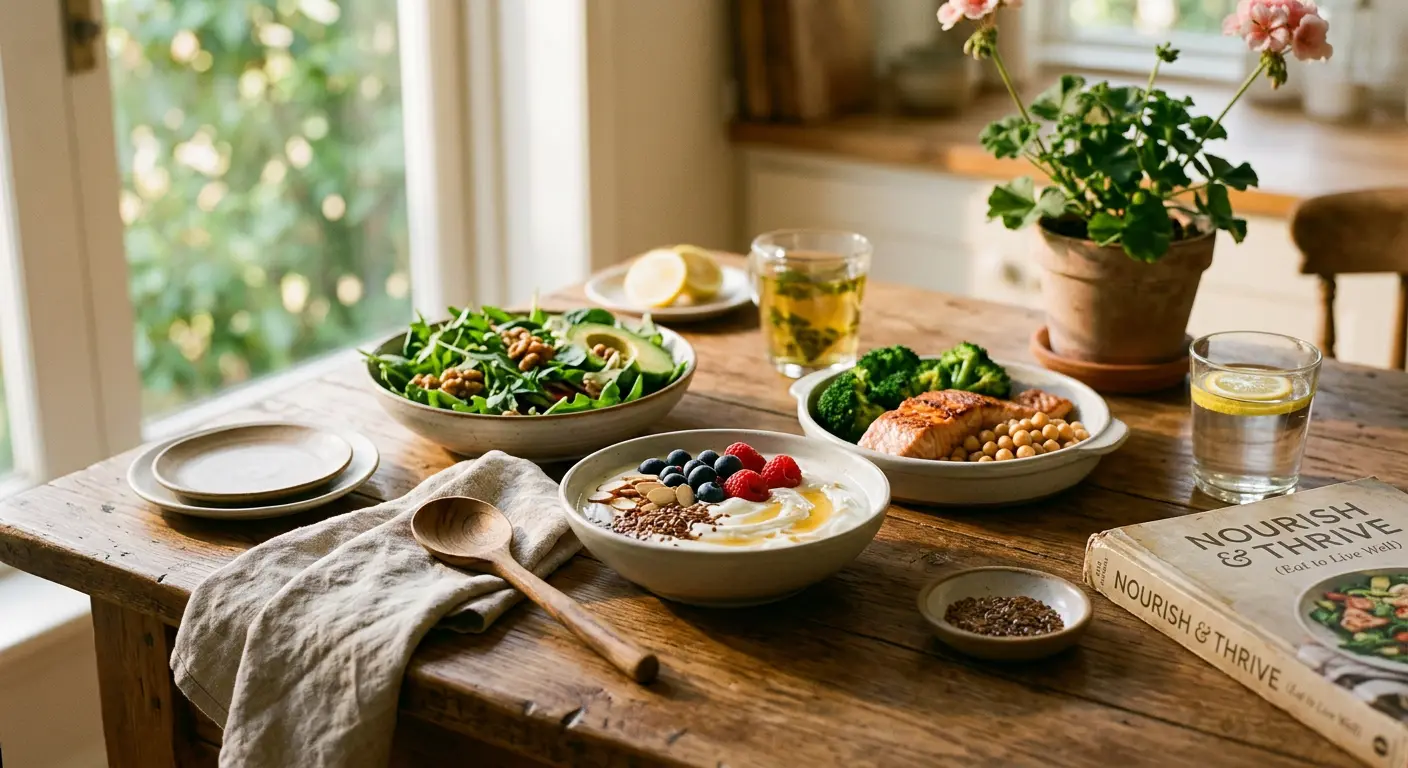
Nutrition in menopause is not about eating less. It is about eating strategically for a body that has quietly changed the rules on you. The same lunch that carried you through an afternoon at 35 now leaves you foggy by three o'clock, and that is a chemistry problem, not a character problem. What follows is the overview: the handful of decisions that do most of the work, with links to the deeper articles where each one is unpacked properly.
What should every meal include to steady blood sugar?
When insulin sensitivity declines, blood sugar management becomes the load-bearing wall of the whole plan. Every meal should include:
- Protein (for satiety and muscle support). Roughly 25 to 30 grams in one sitting is the amount shown to maximally stimulate muscle protein synthesis in both young and older adults (Symons et al., 2009)
- Fiber (for blood sugar regulation, and for the gut bacteria that recycle your estrogen)
- Healthy fats (for hormone production, brain health, and for slowing how fast a meal hits the bloodstream)
The order matters less than the presence of all three. A bowl of oats on its own is a glucose curve. The same oats with Greek yogurt, ground flax, and a handful of walnuts is a meal. If blood sugar is the piece you want to understand properly, start with insulin resistance in perimenopause, which explains why the same carbohydrate behaves differently now.
There is also a reason to take this seriously beyond the waistline. In SWAN, higher fasting insulin measured at age 47, early in perimenopause, predicted an earlier onset and a longer run of hot flashes, and the link to hot flash likelihood held even after body mass index was accounted for (Athar et al., 2026). Blood sugar control is not only a weight strategy. It appears to be a symptom strategy.
How much protein do I actually need after menopause?
More than you were told in your thirties, and probably more than you are eating. Muscle is metabolically expensive tissue, and estrogen loss makes the body less responsive to the usual signals to build it, so the dose has to go up to get the same answer.
The pooled evidence is specific about what works. A meta-analysis of whey protein trials in postmenopausal women found the benefit depended almost entirely on whether resistance training was part of the picture: in the training subgroup, supplementation significantly improved biceps curl strength and lower limb lean mass, while in the no-training subgroup the effect disappeared (Kuo et al., 2022). Protein is not a substitute for lifting. It is the raw material that makes lifting pay.
Two deeper pieces cover the practical numbers: why more protein in menopause is non-negotiable for the total daily target, and optimal protein per meal for muscle synthesis after 45 for how to spread it across the day rather than dumping it all into dinner.
Which nutrients matter most during menopause?
- Calcium and vitamin D for bone density support. Combined calcium and vitamin D modestly improves bone density after menopause, but a 2025 meta-analysis of 11 trials and nearly 44,000 women found no significant reduction in overall fracture risk from supplements alone (Cong et al., 2025). Pairing supplementation with exercise does more than either on its own (Bai et al., 2025)
- Magnesium for sleep, stress, and muscle function
- Omega-3 fatty acids for brain health and inflammation, covered in omega-3 for menopause
- B vitamins for energy metabolism
- Iron in perimenopause, to compensate for heavy or unpredictable periods
Notice what that calcium finding actually says, because it is the pattern for this entire category: supplements move a number, exercise moves the outcome. If you want the honest version of which pills earn their place, smart supplement choices for women over 40 goes through them one at a time.
Is there one eating pattern that works best in menopause?
If you want a single framework rather than a list of rules, the Mediterranean pattern has the most evidence behind it for this specific life stage. A systematic review of Mediterranean diet interventions in menopausal women found that adherence was associated with reductions in weight, blood pressure, triglycerides, total cholesterol, and LDL, along with a better omega-6 to omega-3 ratio (Gonçalves et al., 2024).
That is not a coincidence. The pattern is fiber-heavy, protein-adequate, rich in olive oil and oily fish, and light on refined carbohydrate, which happens to be exactly the shape of a menopause-friendly plate. It also matches what the anti-inflammatory research points to, which is laid out in anti-inflammatory eating for menopause.
You do not have to call it Mediterranean, and you certainly do not have to move to Crete. Build plates that look like that pattern and you have done most of the work.
Do soy and phytoestrogens actually help?
They help some women, with some symptoms, modestly. That is the honest summary, and it is more useful than either the panic or the hype.
A 2025 systematic review and meta-analysis of soy isoflavones in perimenopausal women found significant effects on headache, palpitations, psychosocial symptoms, and depression scores, but no significant effect on hot flashes, sweating, insomnia, fatigue, or vasomotor symptoms overall, and the authors themselves flagged the small sample sizes (Luan et al., 2025). So soy is a reasonable, cheap, whole-food addition to the plate. It is not the hot flash cure it is marketed as. For the full picture, including the breast cancer question that everyone asks and few sources answer straight, see phytoestrogens and menopause.
Does meal timing matter for menopause metabolism?
Eating within a consistent window, starting with a protein-rich breakfast, and avoiding late-night eating can all support your circadian rhythm and metabolic function. Meal timing interacts with the body clock differently in women than in men, and eating late is linked with worse cardiometabolic markers (Minari et al., 2026).
This is one of the cheapest interventions available, because it costs nothing and requires no new food. Shifting dinner earlier and closing the kitchen tends to improve sleep, and better sleep improves next-day appetite regulation, which improves the following day's food choices. The daily timing protocol for circadian rhythm after 40 maps out light, meals, and movement across the day.
Which foods should I limit during menopause?
- Ultra-processed foods, which are both inflammatory and destabilizing for blood sugar. In a long-running Australian cohort, higher ultra-processed food intake predicted incident type 2 diabetes, only partly explained by body weight (Machado et al., 2026)
- Excess sugar and refined carbohydrate, for the insulin spikes and the crash that follows
- Excessive alcohol, which disrupts sleep, depletes nutrients, and affects estrogen metabolism. If wine has started treating you differently, why alcohol hits harder in perimenopause explains the mechanism
Limit is the operative word. Nothing on that list needs to be eliminated forever, and the woman who never eats bread again is not the woman who is still eating this way in five years.
My Perspective
If you take one thing from this page, make it protein plus fiber at breakfast. Not because it is glamorous, but because it is the domino. Women tell me they started eating a real breakfast and their 4pm cravings quietly disappeared, and I always want to say: yes, that is the mechanism, you did not lose your willpower, you were just running your morning on toast and hope.
The other thing I would say is that the perfect menopause diet does not exist, and looking for it is a great way to spend two years not eating differently. Steady blood sugar, enough protein, plenty of plants, less alcohol than you would like. That is the whole architecture. Everything else is decoration.
If you want to see whether these changes are actually doing anything, track the symptoms rather than the scale. The free receipts tracker is built for exactly that, and the free 60-second quiz will tell you which menopause type your symptom pattern most resembles, which changes where you should start.
A note from Marilyn: This article is education, not medical advice. I am a nutrition specialist, not your physician, and I do not know your labs, your medications, or your history. Before you change your diet significantly, start a supplement, or act on anything here, check with your own healthcare provider, especially if you take prescription medication or manage a chronic condition.
Nutrition is one chapter of a much bigger reset. If this plain, science-first approach is what you have been looking for, it is the whole spine of my book, Estrogen Left the Chat: Biohacking Menopause, where I lay out what to eat, how to move, and which midlife biohacks actually deserve your time.