Why does a meal plan beat a random recipe list for one person?
A meal plan and a pile of unrelated recipes solve different problems. A single recipe tells you what to cook once; a plan decides what seven dinners have in common before a single item goes in the cart, so one onion, one bag of spinach or one can of beans gets used two or three times instead of once. That overlap is what keeps a one-person kitchen from ending up with half a head of celery going soft in the crisper drawer. A cross-sectional study of 11,982 Italian women in the Moli-sani Study found that the group who cooked at home most often ate more unprocessed and minimally processed food and less ultra-processed food than the group who cooked least often (Di Costanzo et al., 2025). Home cooking only delivers that benefit consistently when the ingredients on hand actually turn into dinner, which is the job a plan does and a recipe alone does not.
How many meals should a one-week plan for one person actually cover?
Seven dinners, not twenty-one meals. A plan built for every breakfast, lunch and dinner across a week creates more grocery items than one person can use before they spoil, and most of that produce ends up in the bin. The plan below covers dinner only, on the assumption that breakfast repeats (eggs, yogurt, oats) and lunch draws on whatever protein and vegetables are already in the refrigerator from the night before. Two slow cooker recipes, each sized for two servings, cover four of the seven dinners: one serving eaten the night it is made, the second refrigerated or frozen for a night later in the week. The remaining three dinners reuse the extra vegetables, beans and eggs bought for those two recipes rather than pulling in new ingredients, which is what keeps the grocery list short instead of growing a new column for every day.
What goes on a low-waste grocery list for one person?
Fifteen items cover the week: 300 grams of boneless, skinless chicken thighs; three 15-ounce cans (or the dried equivalent) of no-salt-added white beans; two cans of no-salt-added tomatoes; two onions; one head of garlic; one carrot; a few stalks of celery; one zucchini; a small bag of dry pasta; a bag of baby spinach; two lemons; a small bunch of fresh basil; a jar of dried thyme; half a dozen eggs; and two cans of tuna or salmon. Olive oil and salt are pantry staples and are not counted. A study of 1,078 Italian households found that people who started using a shopping list and planning meals more often measurably reduced how much food they wasted (Principato et al., 2020). Every item here appears in at least two of the week's seven dinners: onion and garlic base both slow cooker recipes, and spinach splits between one bowl and a skillet dinner with eggs.
Two slow cooker dinners that turn into four meals this week
The Chicken, White Bean, and Spinach Bowl uses the chicken thighs, one can of white beans, one can of tomatoes, half the onion, half the garlic, half the spinach and one lemon. It cooks on LOW for four to five hours, then spinach and lemon go in for the final ten minutes. Two servings come out: one for dinner that night, one refrigerated for a second dinner within three to four days. At 47 grams of protein per serving, it covers most of a day's target alone; adequate intake runs 1.0 to 1.2 g/kg for healthy older adults, or 70 to 84 grams a day for a 70 kg (154 lb) woman (Heo and Yang, 2025); see protein intake for women over 40 for the full target.
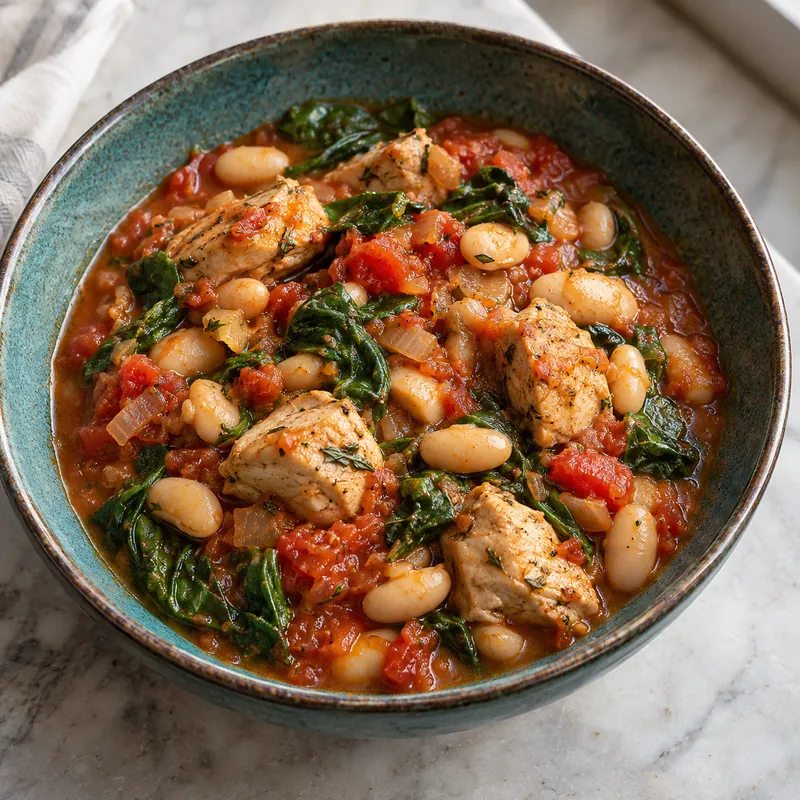
Chicken, White Bean, and Spinach Bowl
White beans share the bowl with chicken, so no separate grain is required by this recipe.
Ingredients
- 300 g (10.6 oz) boneless, skinless chicken thighs, fully thawed, visible fat trimmed
- 300 g (10.6 oz) cooked white beans without salt, drained
- 250 g (8.8 oz) no-salt-added canned tomatoes with juice, chopped
- 100 g (3.5 oz) fresh spinach, washed and chopped
- 80 g (2.8 oz) onion, finely chopped
- 6 g (0.2 oz) garlic, minced
- 2 tsp olive oil
- 25 g (0.9 oz) lemon juice
- 1 tsp dried thyme
- 150 ml water (about 3/4 U.S. cups)
- 1/8 tsp table salt
Method
- Combine onion, beans, tomatoes, garlic, thyme, oil and water. Nestle the chicken in the mixture.
- Cover and cook on LOW, checking from 4 hours until the chicken reaches 165°F / 74°C and the onion is soft.
- Stir in the measured salt. Cut the chicken into bite-size pieces on a clean board and return it. Add spinach, cover for about 10 minutes until wilted and hot, then add lemon. Divide evenly.
Storage: Refrigerate promptly in shallow covered containers; use within 3 days. Reheat to 165°F / 74°C.
Estimated nutrition per serving
- Calories
- 486
- Protein
- 47.2 g
- Fiber
- 13.9 g
- Sodium
- 354 mg
- Carbs
- 49.7 g
- Fat
- 11.8 g
- Sat. fat
- 2.5 g
Buying for one dinner and getting two is the mechanism behind a fifteen-item list covering seven nights: every recipe here is written for two servings, and a one-person household eats across two nights instead of clearing the pot at once.
Why does the minestrone dinner cover two nights instead of one?
Small-Batch Mediterranean Minestrone uses the remaining white beans, the second can of tomatoes, the carrot, the celery, the other half of the onion and garlic, the zucchini and the small bag of pasta. It cooks on LOW until the carrot is tender, then the zucchini and pasta finish on HIGH for the last 25 to 40 minutes, so the pasta never turns to mush waiting in the pot. Like the chicken bowl, it yields two servings from one round of cooking: dinner the night it is made, and a second bowl refrigerated for a night later in the week once the flavors have had time to settle.
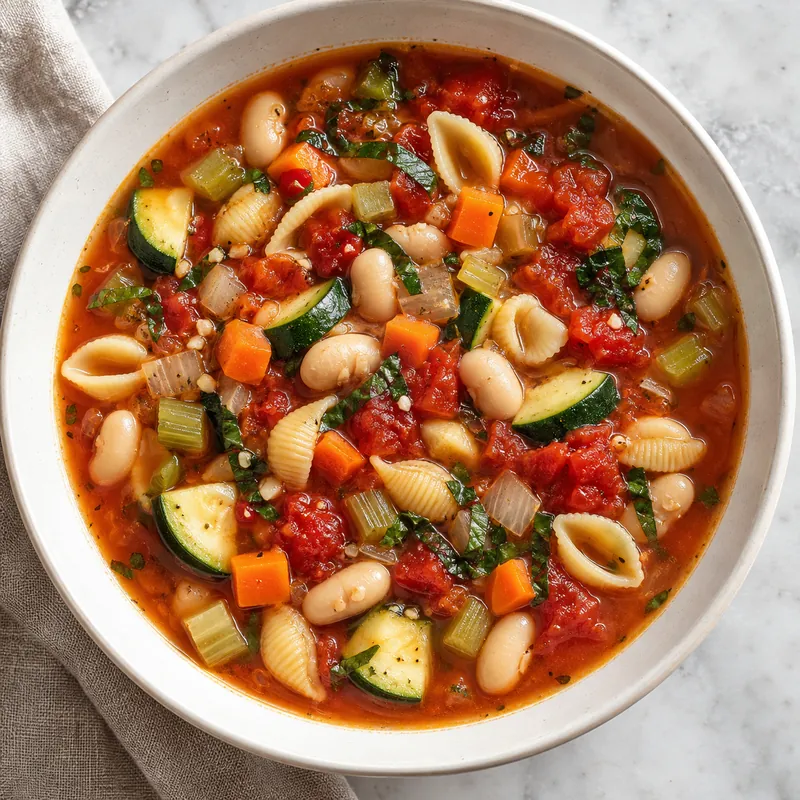
Small-Batch Mediterranean Minestrone
A small amount of pasta joins beans and vegetables in this tomato soup. Add it only near the end.
Ingredients
- 240 g (8.5 oz) cooked white beans without salt, drained
- 250 g (8.8 oz) no-salt-added canned tomatoes with juice, chopped
- 80 g (2.8 oz) carrot, cut into 1/4-inch pieces
- 60 g (2.1 oz) celery, finely chopped
- 60 g (2.1 oz) onion, finely chopped
- 120 g (4.2 oz) zucchini, cut into 1/2-inch pieces
- 50 g (1.8 oz) small dry pasta
- 6 g (0.2 oz) garlic, minced
- 2 tsp olive oil
- 8 g (0.3 oz) fresh basil, chopped
- 450 ml water (about 2 U.S. cups)
- 1/8 tsp table salt
Method
- Use small pasta shells. Combine everything except the zucchini, pasta and basil in the cooker, including the water. Cover and cook on LOW until carrots are tender, checking from 4 hours.
- Switch to HIGH. Add zucchini and pasta, cover and cook about 25 to 40 minutes, stirring once and checking until the pasta is tender.
- Stir in the measured salt. Stir in the basil and divide evenly.
Storage: Refrigerate promptly in shallow covered containers; use within 3 days. Reheat to 165°F / 74°C.
Allergens: wheat. Check packaged ingredients for additional allergens.
Estimated nutrition per serving
- Calories
- 368
- Protein
- 17.9 g
- Fiber
- 13.6 g
- Sodium
- 234 mg
- Carbs
- 63.6 g
- Fat
- 6 g
- Sat. fat
- 0.9 g
Between the two slow cooker recipes, four of the week's seven dinners are already accounted for using ingredients bought once. The remaining three come from what is left over: extra beans, extra tomatoes, extra spinach, the eggs and the tuna or salmon.
What fills the other three dinners without extra shopping?
The three dinners that are not slow cooked lean on whatever the two main recipes did not use. A can of tuna or salmon over the last of the spinach with lemon and olive oil makes one dinner in under ten minutes. A skillet of eggs scrambled with the remaining tomatoes, onion and garlic, the base of a Mediterranean-style shakshuka, makes a second. The third repeats whichever slow cooker dinner used less of its ingredients, usually the minestrone, since a can of beans and a can of tomatoes stretch further than a single serving of chicken thighs. None of these three dinners requires a trip back to the store, which is the real test of a meal plan: not variety on paper, but whether every ingredient bought gets eaten. Does eating alone after 60 change what women eat? looks at why that test matters more alone.
How much sodium should one day of meals contain after menopause?
Most guidance for the general population caps daily sodium at 2,300 milligrams, and people managing blood pressure are often told to aim lower. Every dinner in this plan uses no-salt-added canned beans and tomatoes for that reason: a standard salted can of either can carry 400 to 700 milligrams of sodium per serving on its own, before any salt is added during cooking. The minestrone lands under 235 milligrams of sodium per serving and the chicken bowl under 355, which leaves comfortable room across breakfast and lunch even on a 1,500-milligram target. A cost-effectiveness analysis modeling home cook interventions for salt reduction projected millions of averted cardiovascular events and deaths in women if the approach were adopted at scale (Li et al., 2026). Salt habits formed at home, one grocery list at a time, are the same lever at a population scale. For the mechanism behind rising blood pressure at this life stage, see perimenopause and blood pressure.
How do you freeze and reheat the extra portions safely?
Refrigerate the second serving of each slow cooker dinner within two hours of cooking, in a shallow container so it cools quickly, and eat it within three to four days. If a dinner will not be eaten inside that window, freeze it instead: both recipes hold well for up to three months in a freezer-safe container with the date written on the lid. Thaw frozen portions in the refrigerator overnight rather than on the counter, and reheat to an internal temperature of 165°F (74°C) before eating, checked with a food thermometer rather than by guessing from steam or time. This is the same rule that makes a fifteen-item grocery list stretch across seven dinners in the first place: nothing gets eaten a day too late to be safe, and nothing gets thrown out a day too early. For more on sizing a slow cooker and handling the second portion, see slow cooker recipes for one or two people and low sodium slow cooker recipes for seniors.
My Perspective
I used to buy groceries the way I planned nothing else in my life: on impulse, one aisle at a time, with no idea what Wednesday's dinner had to do with Monday's. Cooking for one made that habit expensive and a little sad, watching a bag of spinach go slimy because I bought it for a recipe I changed my mind about halfway home. What actually fixed it was not more discipline, it was writing the list backward: pick two dinners that share half their ingredients, then fill the gaps with whatever is left in the cart. It is not a system I would have written down as a rule before I lived alone, but it is the only version of meal planning that has ever survived past the first week for me.
All 85 recipes in my new book, The Mediterranean Slow Cooker Cookbook for Seniors, are written for one to two people with sodium per serving, finish times for both settings, and a photo of each dish. If you want to understand what menopause is doing to your appetite and metabolism behind the numbers on a plate, the full story is in Estrogen Left the Chat: Biohacking Menopause. And if your symptoms have left you wondering what is hormonal and what is not, the free Receipts symptom decoder helps you track the pattern, or start with the 60-second quiz to find your menopause type.
A note from Marilyn: This article is for educational purposes and does not replace medical advice. If you follow a therapeutic diet - a sodium limit, a protein restriction for kidney disease or similar - work with your doctor or a registered dietitian before changing how you cook. I am a nutrition specialist, not a physician.