Which slow cooker size is best for one or two people?
For one or two people, the most practical sizes are 1.5 to 3 quarts. A 1.5-quart cooker handles a single breakfast dish or a soup that stretches to two generous bowls. A 2-quart handles most two-serving dinner recipes - soups, stews and chicken dishes - without crowding the bowl or wasting energy on a mostly empty appliance. A 3-quart gives a little extra room when a recipe runs larger than expected and still fits most standard kitchen cabinets without difficulty.
The measurement to check before buying is fill level, not just listed capacity. Most manufacturers specify between half full and two-thirds full. Under-filled, a cooker heats unevenly and may cook food faster than the recipe intends, drying out the meal before the timer goes off. Over-filled, the lid cannot seal properly, steam escapes, and timing becomes unpredictable. When a recipe in the book lists a cooker size, that quantity of food is sized to land in that fill window. Check the listed cooker size before you begin, and check your own model's manual for any model-specific guidance that overrides general advice.
What changes when you halve a slow cooker recipe?
Most changes follow a simple pattern when cooking for two: halve the solids, the aromatics, the protein. Liquid is the exception. Slow cookers trap steam, and almost no evaporation happens over the cooking hours. A full recipe is calibrated for a specific ratio of liquid to food; halving the quantities shifts that ratio. A shallower volume of liquid covers less surface area, the relative steam effect changes, and the dish often tightens too much or dries out before it finishes.
The practical fix is to add back about 20 to 30 percent more liquid than a straight halving gives you - roughly an extra quarter cup for a recipe that originally called for a full cup - then taste and adjust at the end. Begin checking for doneness about 30 minutes earlier than the recipe states when cooking on HIGH, since a shallower bowl can reach its target temperature sooner. All other rules stay unchanged: thaw meat and poultry fully before starting, keep raw meat separate from vegetables during preparation, and add fish, dairy or leafy greens only at the end of the cook time, not at the beginning.
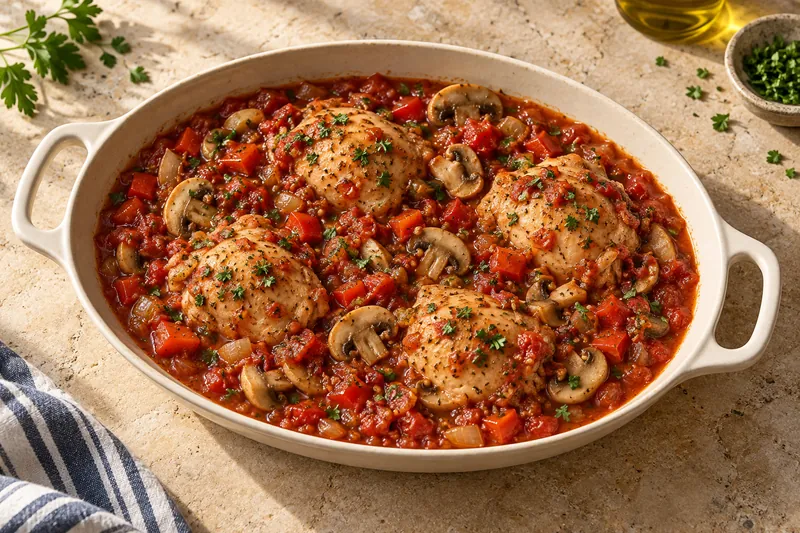
Chicken Cacciatore for Two
Mushrooms and peppers cook in a tomato sauce around the chicken. Serve the sauce with the meat rather than leaving it in the bowl.
Ingredients
- 360 g (12.7 oz) boneless, skinless chicken thighs, fully thawed, visible fat trimmed
- 300 g (10.6 oz) no-salt-added canned tomatoes with juice, chopped
- 150 g (5.3 oz) white mushrooms, sliced
- 120 g (4.2 oz) red bell pepper, seeded and diced
- 70 g (2.5 oz) onion, finely chopped
- 6 g (0.2 oz) garlic, minced
- 2 tsp olive oil
- 1 tsp dried oregano
- 8 g (0.3 oz) fresh parsley, chopped
- 80 ml water (about 1/4 U.S. cups)
- 1/8 tsp table salt
Method
- Put the onion, mushrooms and pepper in the bowl. Add the chicken, tomatoes with juice, garlic, oregano, oil and water.
- Cover and cook on LOW. Check from 4 hours until the chicken reaches 165°F / 74°C and the vegetables are soft.
- Stir in the measured salt. Stir the parsley into the sauce. Divide the chicken and sauce equally. Bread or another accompaniment is additional to the nutrition panel.
Storage: Refrigerate promptly in shallow covered containers; use within 3 days. Reheat to 165°F / 74°C.
Estimated nutrition per serving
- Calories
- 335
- Protein
- 40.2 g
- Fiber
- 5.9 g
- Sodium
- 343 mg
- Carbs
- 16.1 g
- Fat
- 12.8 g
- Sat. fat
- 2.8 g
How do you store and freeze the second portion?
Refrigerate leftovers within two hours of cooking, or within one hour if the room temperature is above 90 degrees Fahrenheit / 32 degrees Celsius. Transfer the second portion to a shallow container rather than leaving it in the slow cooker bowl - shallow containers cool faster and reach a safe storage temperature more quickly than a deep ceramic insert sitting at room temperature. Most slow-cooker soups, stews, chicken and legume dishes keep for three to four days at 40 degrees Fahrenheit / 4 degrees Celsius or below. Fish dishes should be used within two days.
If you cooked a batch specifically to have a second meal ready later in the week, freeze anything you will not eat within three days. Label each container with the recipe name and the date you cooked it. Reheat frozen or refrigerated portions on the stove, in the microwave or in the oven rather than bringing them up from cold in the slow cooker - the slow cooker is designed to cook raw food with low, steady heat, not to raise cold food quickly to a safe temperature. Everything reheated should reach 165 degrees Fahrenheit / 74 degrees Celsius throughout.
Does fill level really matter in a slow cooker?
Fill level matters more than most cooks expect, especially with smaller appliances. When the bowl is less than half full, food heats unevenly, liquid reduces faster than the recipe anticipates, and the bottom of the dish can dry out or scorch before the top is done. When the bowl is more than two-thirds full, the lid cannot seal, steam escapes, and cooking time extends in ways that are difficult to predict. For one-and-two-person cooking, this creates a specific trap: do not put a two-serving recipe into a 5- or 6-quart cooker expecting the same result as a 2-quart bowl. The large empty space changes how the liquid behaves.
Firm vegetables - carrots, potatoes, parsnips - go in first, closest to the heating element, because they take the longest to soften. Liquid is added to surround but not submerge them. Dairy products and leafy greens go in at the end, after cooking is complete, because prolonged heat causes dairy to separate and greens to turn limp and unappetizing. If a recipe reserves yogurt for serving, leave it out of the cooking bowl entirely and stir it in just before eating.
Is it safe to leave a slow cooker on when no one is home?
Modern slow cookers sold in the United States are tested to safety standards that require the appliance to handle extended unattended runs without becoming a fire hazard. The USDA and most manufacturers consider a slow cooker left on LOW or HIGH while you are away to be generally safe, provided it is placed on the surface specified in the manual, has required clearance around it, has a tight-fitting lid, and the cord is kept away from heat sources and water.
For people living alone, preparation before you leave matters most. Read the recipe's finishing steps before you go out, not when you get home - if a dish adds fish, yogurt or greens at the end, set a phone reminder for the right moment. Know what your model does when cooking finishes: some switch automatically to WARM, some switch off. Food held on WARM should remain at or above 140 degrees Fahrenheit / 60 degrees Celsius, checked with a food thermometer when you return. Food in an unpowered cooker after cooking ends is safe for two hours; after that it should be discarded, not reheated. Our article on eating alone after 60 and what it does to nutrition covers the broader picture of how managing meals solo affects food choices and intake.
Why does protein matter more for women cooking for one after 50?
After menopause, muscle loss accelerates unless protein intake and movement compensate for it. Muscle determines balance, mobility and recovery from illness - losses that do not show up on a scale until they are already significant. A 2025 review in Post Reproductive Health found that dietary patterns higher in protein and lower in processed food were consistently linked to better body composition and lower cardiometabolic risk in postmenopausal women (Post Reproductive Health, 2025).
Women cooking for one tend to eat smaller, less protein-dense meals without meaning to. A bowl of crackers with cheese is a meal; a small pot of chicken cacciatore with mushrooms and tomato sauce is a meal that delivers over 40 grams of protein per portion at under 350 milligrams of sodium. The slow cooker makes the second option as easy as the first, with a second portion already stored for tomorrow. Our full guide to protein and muscle in menopause covers how much and how often research says women over 50 need. For the sodium angle, especially if blood pressure has been creeping up, see why blood pressure rises in perimenopause.
How does the Mediterranean diet fit into a 2-quart cooker?
The Mediterranean diet is the pattern with the strongest consistent evidence for women after menopause. A 2025 randomized controlled trial in adults over 65 found that three years of Mediterranean diet adherence produced a 0.9 g/cm2 improvement in lumbar spine bone density compared with the control group (JAMA Network Open, 2025). A 2025 meta-analysis of 11 prospective studies found that high adherence was linked to a 29% lower risk of hip fracture compared with low adherence (Nutrition Reviews, 2025). The European Menopause and Andropause Society calls it the most evidence-supported dietary pattern for reducing cardiovascular and metabolic risk after menopause (Maturitas, 2020).
The ingredients that produce those outcomes - olive oil, legumes, fish, tomatoes, vegetables and herbs - are exactly what a small slow cooker handles best. A 2-quart bowl with split red lentils, one carrot, an onion, garlic, cumin and a lemon produces a thick soup with 17 grams of protein and over 9 grams of fiber per two-person portion at under 210 milligrams of sodium. For the full picture on eating to protect your heart after menopause, see the diet pattern that actually protects your heart in menopause. For the anti-inflammatory side of the same pattern, see anti-inflammatory eating for menopause.
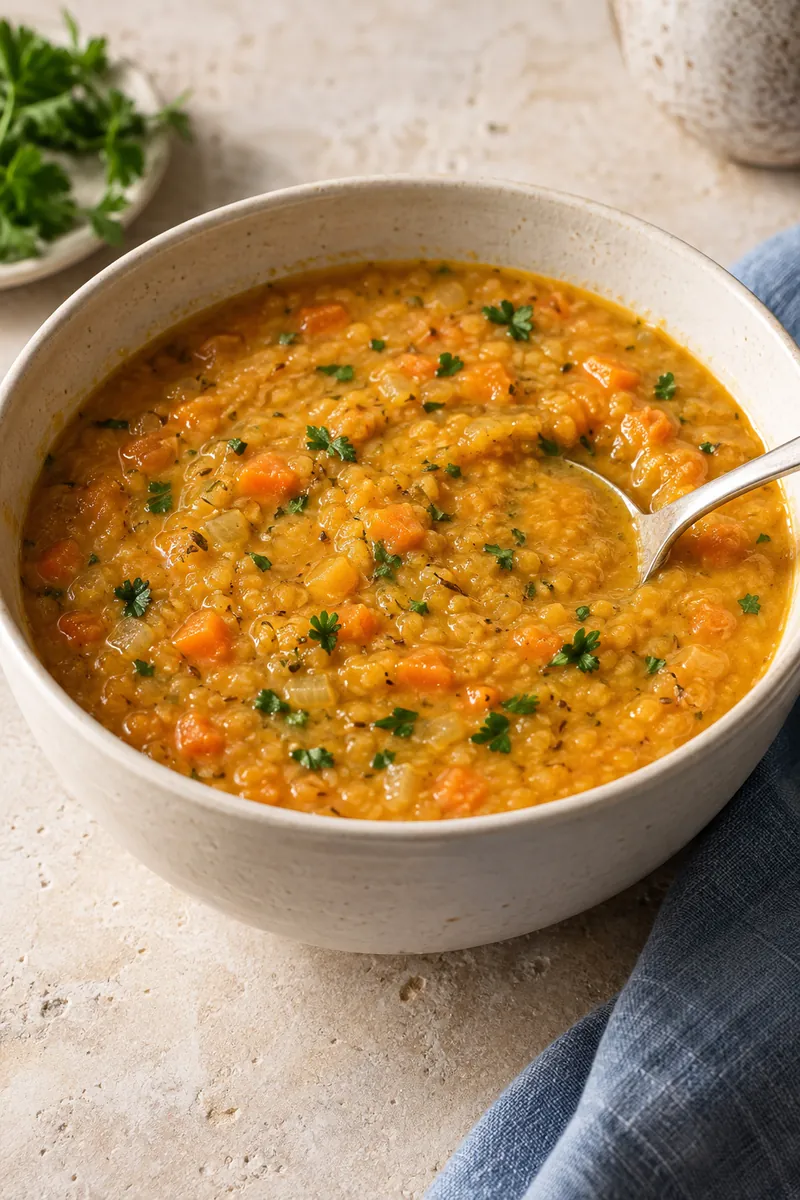
Red Lentil Soup with Lemon
Red lentils break down into a thick soup. Stir well before serving to bring the vegetables and lentils together.
Ingredients
- 130 g (4.6 oz) split red lentils, dry, rinsed
- 100 g (3.5 oz) carrot, cut into 1/4-inch pieces
- 80 g (2.8 oz) onion, finely chopped
- 6 g (0.2 oz) garlic, minced
- 2 tsp olive oil
- 1/2 tsp ground cumin
- 30 g (1.1 oz) lemon juice
- 6 g (0.2 oz) fresh parsley, chopped
- 650 ml water (about 2 3/4 U.S. cups)
- 1/8 tsp table salt
Method
- Put the carrots, onion and garlic in the bowl. Add the rinsed lentils, cumin, oil and water; stir and cover.
- Cook on LOW until the lentils have collapsed and the carrots are soft, checking from 4 hours.
- Stir in the measured salt. Stir vigorously to thicken the soup. Add the lemon and parsley, then divide equally.
Storage: Refrigerate promptly in shallow covered containers; use within 3 days. Reheat to 165°F / 74°C.
Estimated nutrition per serving
- Calories
- 316
- Protein
- 17.3 g
- Fiber
- 9.3 g
- Sodium
- 202 mg
- Carbs
- 52.2 g
- Fat
- 5.5 g
- Sat. fat
- 0.8 g
My Perspective
I cooked from a 6-quart slow cooker for years after my children left home, and the first few months were fine - I made big batches and froze them. The problem came later, when I stopped wanting to plan that far ahead. Eight servings of anything began to feel like homework when it was just me. The 2-quart is the cooker I should have started with: light enough to wash at the sink, small enough to store in a standard cabinet, and sized for dinner tonight plus a second portion already put away. It is also the cooker that makes eating enough protein feel like a reasonable decision on a Tuesday evening rather than a project.
All 85 recipes in my new book, The Mediterranean Slow Cooker Cookbook for Seniors, are written for one to two people with sodium per serving, finish times for both settings, and a photo of each dish. If you want to understand what menopause is doing to your muscle and metabolism behind the numbers on a plate, the full story is in Estrogen Left the Chat: Biohacking Menopause. And if your symptoms have left you wondering what is hormonal and what is not, the free Receipts symptom decoder helps you track the pattern, or start with the 60-second quiz to find your menopause type.
A note from Marilyn: This article is for educational purposes and does not replace medical advice. If you follow a therapeutic diet - a sodium limit, a protein restriction for kidney disease or similar - work with your doctor or a registered dietitian before changing how you cook. I am a nutrition specialist, not a physician.