Why does blood pressure rise after menopause, and what does sodium have to do with it?
Estrogen supports the kidneys in managing sodium excretion. When estrogen falls, that protection goes with it. Research published in Steroids found that estrogen directly modulates renal sodium handling, meaning the kidney's ability to clear excess salt efficiently is partly estrogen-dependent (Thomas & Harvey, 2023). A Current Hypertension Reports review found that in postmenopausal animal models, excess sodium promoted immune-cell infiltration and inflammation that did not occur at normal sodium levels - controlling blood pressure alone was not enough to prevent this inflammatory state (Vlachovsky et al., 2023). In a study of postmenopausal women in rural Zambia, hypertension was strongly linked to dietary patterns including sodium intake, independent of body weight (Chalwe et al., 2021). The consequence: a body that handles the same sodium intake differently at 65 than it did at 45. That is modifiable. For the full hormonal mechanism, perimenopause and blood pressure: why yours is rising covers it in detail.
Does reducing sodium actually lower blood pressure after 60?
The clearest answer comes from a 2025 randomized controlled trial in JAMA Internal Medicine. The DASH4D trial assigned adults with a mean age of 66 - two-thirds of whom were women, many already taking two or more antihypertensive medications - to either a DASH-style diet with reduced sodium or a comparison diet with higher sodium. The DASH4D diet with lower sodium reduced end-of-period systolic blood pressure by 4 millimeters of mercury compared with the higher-sodium comparison diet (Pilla et al., 2025). A 4 mmHg reduction is meaningful: population-level data consistently show that a sustained 2 to 3 mmHg reduction in systolic blood pressure is associated with fewer cardiovascular events. This effect held in a population that was largely already medicated, which means sodium reduction is additive to, not a substitute for, prescribed treatment. If you are managing blood pressure and want to understand the full dietary picture, the diet pattern that actually protects your heart in menopause covers the broader evidence base.
What are the hidden sodium traps in most slow cooker recipes?
Most slow cooker recipes get their sodium from three places that are easier to miss than the salt shaker. A single stock cube adds roughly 800 to 1,000 milligrams to a two-person pot before the vegetables are in - nearly half the 2,300 mg daily reference for adults in one step. Standard canned tomatoes add 200 to 400 mg per cup; no-salt-added versions have under 30 mg for the same amount. Cured and smoked meats - chorizo, smoked ham, anchovies used as background flavor - contribute another 400 to 800 mg in a small quantity. Together, those three sources can push a simple bean stew above 1,000 mg per serving without any table salt being added. Recipes built around no-salt-added canned tomatoes, unsalted or low-sodium broth, and no cured meat avoid all three traps before cooking starts. A measured amount of salt added at the end hits the tongue directly and delivers flavor at a fraction of what is needed at the start of a long braise.
Canned beans or dried beans: which gives you less sodium in a slow cooker meal?
For most people cooking for one or two, no-salt-added canned beans are the practical answer. Cooked from dried, white beans and lima beans contain essentially no sodium - but dried beans need pre-soaking and several hours before the slow cooker even starts, which is a real barrier on a weeknight. Standard canned beans solve the timing problem and introduce a new one: the packing liquid and beans together carry 300 to 400 mg of sodium per cup, and rinsing reduces but does not reliably eliminate that - different brands start at different sodium levels. No-salt-added canned beans contain 10 to 30 mg per cup and require no extra step. The book's recipes specify "cooked white beans without salt" and "cooked large lima beans without salt" - that wording is the sodium control. Follow it, and the milligram figure in the nutrition panel is accurate. Swap in regular canned beans and it is not.
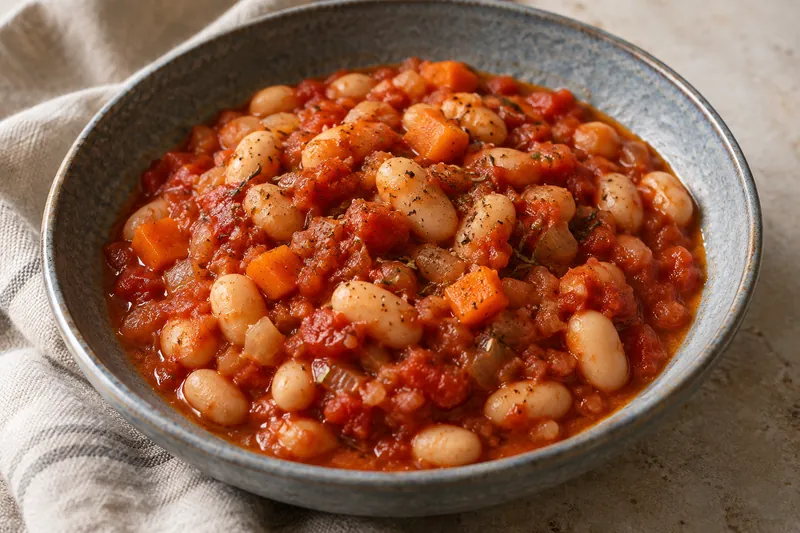
White Bean, Tomato, and Rosemary Stew
Mash a few of the beans against the side of the bowl to thicken the tomato sauce.
Ingredients
- 360 g (12.7 oz) cooked white beans without salt, drained
- 300 g (10.6 oz) no-salt-added canned tomatoes with juice, chopped
- 100 g (3.5 oz) carrot, cut into 1/4-inch pieces
- 80 g (2.8 oz) onion, finely chopped
- 6 g (0.2 oz) garlic, minced
- 2 tsp olive oil
- 3/4 tsp dried rosemary, crushed
- 1/8 tsp ground black pepper
- 200 ml water (about 3/4 U.S. cups)
- 1/8 tsp table salt
Method
- Put the carrot and onion at the bottom. Add the beans, tomatoes with juice, garlic, rosemary, pepper, oil and water.
- Cover and cook on LOW, checking from 4 hours, until the carrot is tender.
- Stir in the measured salt. Mash a few beans into the cooking liquid and stir. Divide the stew evenly between two bowls.
Storage: Refrigerate promptly in shallow covered containers; use within 3 days. Reheat to 165°F / 74°C.
Estimated nutrition per serving
- Calories
- 357
- Protein
- 19.8 g
- Fiber
- 16.6 g
- Sodium
- 212 mg
- Carbs
- 60.3 g
- Fat
- 5.8 g
- Sat. fat
- 0.9 g
Which broth and tomato labels should you look for?
Broth labeling has three tiers worth knowing. "No salt added" means no sodium was added during processing - the food may still contain a small amount naturally, but it is typically under 20 mg per cup. "Low sodium" means 140 mg or less per stated serving. "Reduced sodium" means at least 25 percent less than the regular version, which in a high-sodium category like commercial broth can still mean 500 mg or more per cup. For slow cooker cooking, "no salt added" is the target for canned tomatoes and canned beans. For broth, "low sodium" (140 mg or less per cup) is a workable baseline; homemade unsalted stock is better. Both recipes in this article use water rather than broth, which removes this variable entirely. The chapter on the small-household pantry in the cookbook covers the same labeling distinctions for any packaged ingredient: compare the sodium per the same measured quantity, not the per-serving figure, which can describe different volumes on two different packages.
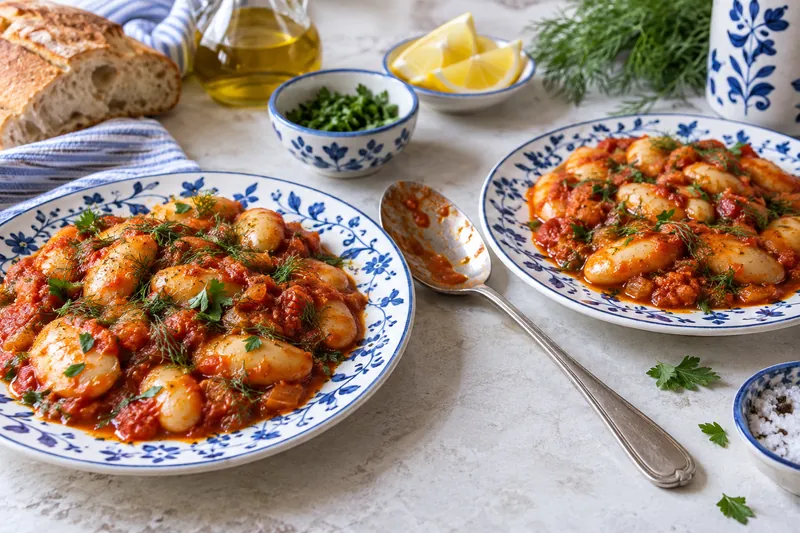
Tomato-Braised Gigantes-Style Beans
Large cooked lima beans stand in for Greek gigantes beans. They soften in a tomato sauce with carrot, celery and dill.
Ingredients
- 420 g (14.8 oz) cooked large lima beans (butter beans), without salt, drained
- 350 g (12.3 oz) no-salt-added canned tomatoes with juice, chopped
- 120 g (4.2 oz) carrot, cut into 1/4-inch pieces
- 70 g (2.5 oz) celery, finely chopped
- 80 g (2.8 oz) onion, finely chopped
- 6 g (0.2 oz) garlic, minced
- 1 tbsp olive oil
- 1 tsp dried oregano
- 10 g (0.4 oz) fresh dill, chopped
- 1/8 tsp table salt
- 120 ml water
Method
- Put carrot, celery and onion in the bowl. Add fully cooked lima beans, tomatoes with juice, garlic, oregano, oil and water.
- Cover and cook on LOW, checking from 4 hours, until carrot and celery are soft. Stir gently so that some large beans remain whole.
- Add salt and dill. Divide the beans, vegetables and tomato sauce evenly.
Storage: Refrigerate promptly in shallow covered containers; use within 3 days. Reheat to 165°F / 74°C.
Estimated nutrition per serving
- Calories
- 383
- Protein
- 19.4 g
- Fiber
- 21.3 g
- Sodium
- 244 mg
- Carbs
- 62.1 g
- Fat
- 8.3 g
- Sat. fat
- 1.2 g
How much sodium per day is a realistic target for women over 60?
The U.S. Dietary Guidelines set the sodium reference at 2,300 mg per day for adults. The American Heart Association recommends 1,500 mg for people with elevated blood pressure or established cardiovascular risk - a threshold that applies to a large proportion of women after menopause. Neither figure is a hard safety line; they describe the range where population-level cardiovascular risk is meaningfully reduced. In practical cooking terms, a 250 mg main dish, a 150 mg side, and a 200 mg breakfast together total 600 mg, leaving substantial room for sodium from condiments, snacks, and bread. The most useful approach is not counting every meal to the milligram but learning which ingredient categories carry most of the load - broth, canned goods, cured meat, and packaged seasoning mixes - and defaulting to lower-sodium versions. For women on blood pressure medication, these numbers are a starting reference to reconcile with individual clinical guidance.
What does a low-sodium Mediterranean slow cooker plate look like for one or two people?
Mediterranean slow cooker cooking is a natural fit for low-sodium eating - not because Mediterranean food is traditionally low in salt, but because its building blocks (legumes, vegetables, olive oil, dried herbs, no-salt-added canned tomatoes) happen to be low-sodium ingredients. Both recipes in this article use that base. The White Bean, Tomato, and Rosemary Stew delivers 212 mg of sodium per serving; the Tomato-Braised Gigantes-Style Beans comes in at 244 mg. Both are substantial, protein-forward plates - 19 to 20 grams of protein per serving and 16 to 21 grams of fiber - that also supply a meaningful amount of potassium, a mineral that works against sodium's blood pressure effect. For more legume-based recipes sized for one or two, slow cooker recipes for one or two people covers the sizing and portioning detail. For the omega-3 fish side of the Mediterranean pattern, slow cooker fish recipes covers the timing technique that keeps fish from overcooking in a low-and-slow cooker.
My Perspective
Salt is one of those places where the standard advice - "use herbs and spices instead" - is not wrong, but it misses the actual problem. Herbs and spices cannot fix a recipe that starts with a salty broth, a salty can of tomatoes, and a piece of chorizo. The work is upstream, at the pantry. Swap the broth. Choose no-salt-added cans. Leave the cured meat out. Then the 1/8 teaspoon of table salt at the end of the recipe is doing real work, not just adding to an existing load. Women I talk with are often surprised that the low-sodium version tastes brighter, not blander - because the actual flavors of the beans, the tomatoes, and the rosemary are no longer buried under a salt baseline. If your blood pressure has been trending up, protein and muscle support in menopause and anti-inflammatory eating for menopause are worth reading alongside this one. The free 60-second quiz includes a blood pressure and cardiovascular section, and the free Receipts tracker is the place to log whether these changes are actually showing up in how you feel.
A note from Marilyn: This article is education, not medical advice. I am a nutrition specialist, not your physician, and I do not know your medications, your kidney function, or your clinical history. Before significantly reducing your sodium intake - especially if you take blood pressure medication or diuretics - talk with your prescribing doctor. Milligram figures come from specific book recipes; real-world sodium will vary with the brands you use.
For the full approach - 85 kitchen-tested Mediterranean slow cooker recipes sized for one or two people - the cookbook is The Mediterranean Slow Cooker Cookbook for Seniors.
Frequently asked questions
Why does blood pressure go up after menopause?
Blood pressure tends to rise after menopause partly because estrogen supports the kidneys in managing sodium excretion. When estrogen falls, this protection diminishes and the body becomes more salt-sensitive. Research published in Steroids (2023) found that estrogen directly modulates renal sodium handling (Thomas & Harvey, 2023), and a Current Hypertension Reports review found that excess sodium promotes inflammatory immune-cell infiltration in postmenopausal models that does not occur at normal sodium levels (Vlachovsky et al., 2023).
Does rinsing canned beans remove sodium?
Rinsing removes some sodium from the packing liquid, but the reduction is not fixed or predictable - brands vary in their starting sodium content. No-salt-added canned beans, which typically contain 10 to 30 milligrams per cup, are the more reliable low-sodium choice and require no extra preparation. When a recipe specifies cooked beans without salt, that wording is the sodium control and should be followed exactly rather than substituting rinsed regular canned beans.
What is the DASH diet, and does it work for women over 60?
DASH (Dietary Approaches to Stop Hypertension) is an eating pattern built around vegetables, fruit, whole grains, legumes, and limited sodium, saturated fat, and red meat. A 2025 randomized controlled trial in JAMA Internal Medicine - the DASH4D trial - enrolled adults with a mean age of 66, two-thirds of them women, and found that a DASH-style diet combined with reduced sodium lowered end-of-period systolic blood pressure by 4 millimeters of mercury compared with a higher-sodium comparison diet (Pilla et al., 2025).
How much sodium is in a typical slow cooker recipe?
A home slow cooker recipe using one stock cube, standard canned tomatoes, and regular canned beans can reach 1,000 to 1,500 milligrams of sodium per serving before any salt is added at the table. The three largest contributors are the stock cube (800 to 1,000 mg per cube), standard canned tomatoes (200 to 400 mg per cup), and regular canned beans (300 to 400 mg per cup). Substituting no-salt-added canned tomatoes and beans and using water rather than broth can bring a two-person serving to under 300 mg.