Is the Mediterranean diet a good fit for seniors over 60?
Yes, with adjustments, and the evidence is strongest for muscle. A 2025 systematic review and meta-analysis in Nutrients pooled 11 studies in adults over 50 and found the Mediterranean pattern associated with roughly 40% lower odds of sarcopenia (OR 0.62, 95% CI: 0.40-0.95), the strongest result among the dietary patterns tested (Ruiz-Valenzuela et al., 2025). That matters because sarcopenia, the loss of muscle mass and function, affects an estimated 10% to 27% of adults over 60, and raises the risk of falls, frailty and disability. A 2025 narrative review also reports that Mediterranean and DASH-style eating are consistently associated with better muscle mass, strength and function (Heo and Yang, 2025). Both findings are associations from studies of eating patterns, not proof that food alone protects muscle. What general guides skip is daily reality: the pattern assumes strong teeth, a healthy appetite and a full kitchen. For the heart side of the evidence, the diet pattern that actually protects your heart in menopause goes through it in depth.
How do I follow the Mediterranean diet if chewing is difficult?
Chewing problems are a bigger nutrition risk than most Mediterranean guides admit. A 2025 umbrella review of 16 systematic reviews covering 518,647 participants found that malnutrition risk was linked to masticatory dysfunction (RR 1.75) and to missing teeth without dentures (RR 1.71), but not to dental prostheses (RR 1.01) (Asaad et al., 2025). In plain terms, well-fitting dentures did not carry the added risk, so a dental visit can be a nutrition step. The traditional Mediterranean plate leans on hard textures: raw vegetables, crusty bread, whole nuts, tough grilled meat. The foods that soften easily are just as Mediterranean: beans, lentils, braised chicken thighs, flaked fish, and vegetables cooked until tender in soups and stews. Slow cooking does that work for you. Butter Beans with Lemon and Greens is mashed slightly into its own cooking liquid, so a spoon is all it needs. Chop nuts fine and stir them into yogurt instead of eating them whole.
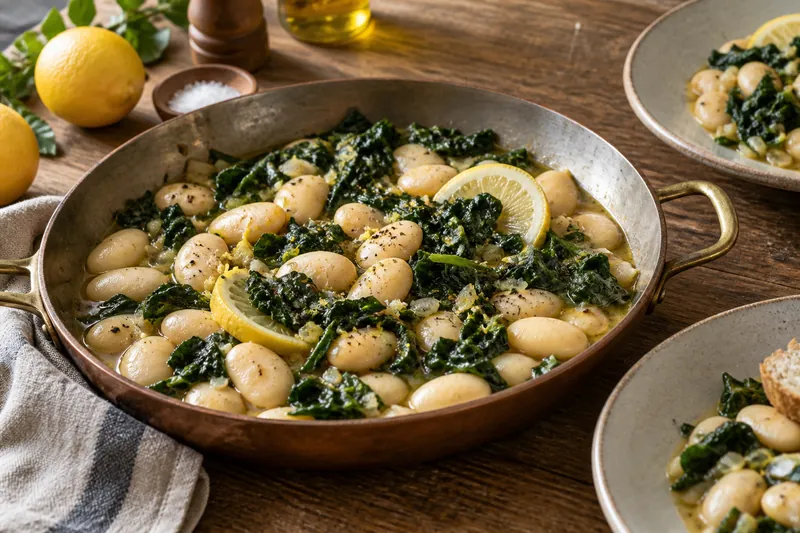
Butter Beans with Lemon and Greens
Large butter beans make a substantial bowl with chopped greens. A little of the mashed bean thickens the cooking liquid.
Ingredients
- 400 g (14.1 oz) cooked large lima beans (butter beans), without salt, drained
- 120 g (4.2 oz) carrot, cut into 1/4-inch pieces
- 80 g (2.8 oz) onion, finely chopped
- 120 g (4.2 oz) kale leaves, tough stalks removed, finely chopped
- 8 g (0.3 oz) garlic, minced
- 1 tbsp olive oil
- 30 g (1.1 oz) lemon juice
- 8 g (0.3 oz) fresh dill, chopped
- 1/8 tsp table salt
- 300 ml water
Method
- Combine the fully cooked butter beans, carrot, onion, garlic, oil and water in the cooker. Cover and cook on LOW until the carrot is tender, checking from 4 hours.
- Mash a few beans into the liquid. Stir in the kale, cover and cook for another 20 to 30 minutes, until the leaves are tender.
- Add lemon, dill and salt. Divide all beans, greens and liquid evenly.
Storage: Refrigerate promptly in shallow covered containers; use within 3 days. Reheat to 165°F / 74°C.
Estimated nutrition per serving
- Calories
- 362
- Protein
- 18.8 g
- Fiber
- 19 g
- Sodium
- 234 mg
- Carbs
- 56.5 g
- Fat
- 8.7 g
- Sat. fat
- 1.3 g
What should seniors over 60 do about low appetite on a Mediterranean diet?
Poor appetite is not a minor inconvenience. A 2026 analysis of the Survey of Health, Ageing and Retirement in Europe, covering adults aged 50 and older, found that poor appetite predicted later low handgrip strength, physical disability and lower quality of life, with the strongest effects after age 66 and incidence rates of all outcomes nearly doubled compared with good appetite (Hussain et al., 2026). Women showed greater susceptibility to mobility limitations. Small, dense meals work better than large plates. Build a bowl that delivers protein and fiber in a modest volume, season it with lemon, dill or garlic so it tastes worth finishing, and measure the olive oil rather than skipping it, because oil adds energy in very few bites. Eat the largest meal when appetite is strongest. A loss of appetite that persists, or weight loss you did not intend, deserves a call to a doctor, since medicines and changes in taste or smell can both be the cause.
How much protein do seniors over 60 need on a Mediterranean diet?
Enough, but only when the plate is planned. The 2025 narrative review puts adequate intake at 1.0 to 1.2 grams per kilogram of body weight per day for healthy older adults, and above 1.2 grams for anyone with sarcopenia or frailty (Heo and Yang, 2025). For a 70 kg (154 lb) woman, that is 70 to 84 grams a day. A plate built mostly from vegetables and beans can fall short: Butter Beans with Lemon and Greens supplies 18.8 grams per serving, while Chicken, Orzo, and Spinach Soup supplies 33.7 grams. Spreading protein across breakfast, lunch and dinner from fish, poultry, eggs, dairy, beans and lentils works better than loading it into one meal. The same review stresses that nutrition works best alongside resistance exercise. Optimal protein per meal for muscle synthesis after 45 and protein intake for women over 40 explain the per-meal targets. Anyone with kidney disease should confirm protein targets with their care team first.
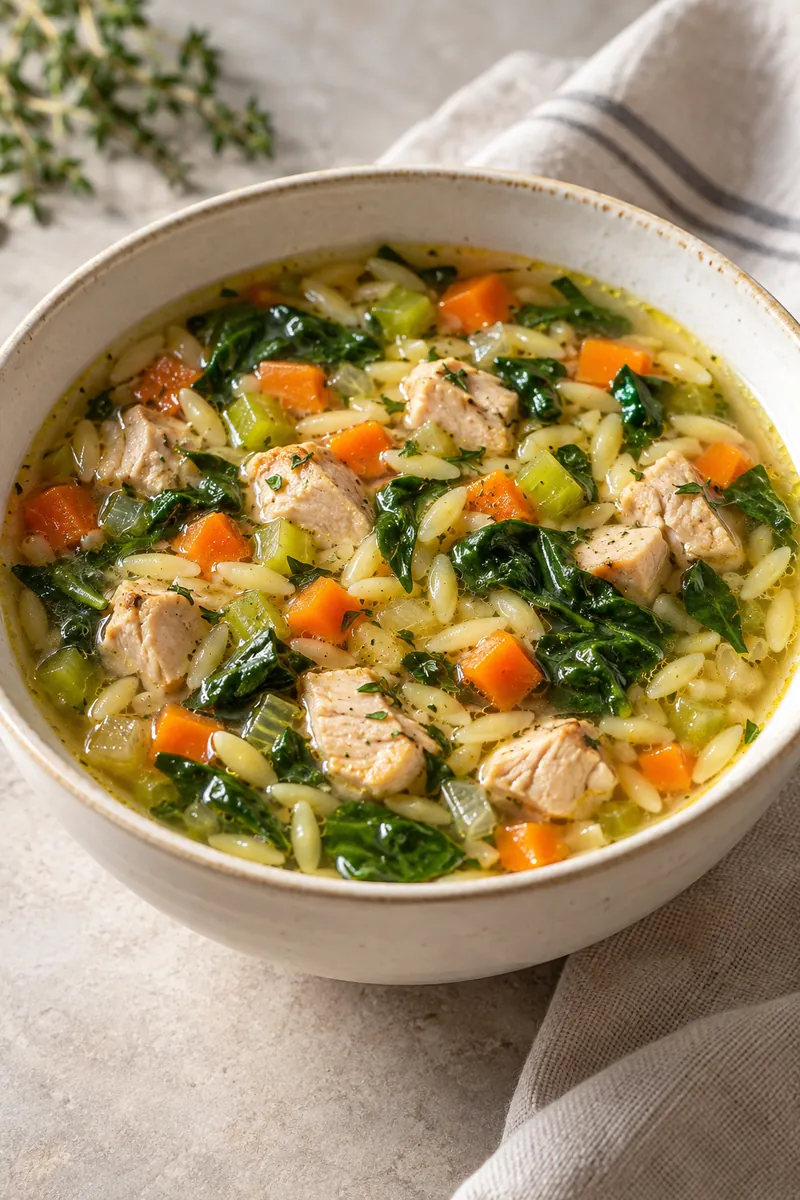
Chicken, Orzo, and Spinach Soup
The chicken cooks first. Orzo is added to the hot soup near the end so it does not spend hours softening.
Ingredients
- 280 g (9.9 oz) boneless, skinless chicken thighs, fully thawed, visible fat trimmed
- 60 g (2.1 oz) small dry pasta
- 100 g (3.5 oz) carrot, cut into 1/4-inch pieces
- 60 g (2.1 oz) celery, finely chopped
- 60 g (2.1 oz) onion, finely chopped
- 70 g (2.5 oz) fresh spinach, washed and chopped
- 6 g (0.2 oz) garlic, minced
- 1 tsp olive oil
- 1/2 tsp dried thyme
- 20 g (0.7 oz) lemon juice
- 600 ml water (about 2 1/2 U.S. cups)
- 1/8 tsp table salt
Method
- Use orzo for the pasta. Put the carrot, celery and onion in the bowl, followed by chicken, garlic, thyme, oil and water. Cover and cook on LOW.
- From 4 hours, check that the chicken reaches 165°F / 74°C and the vegetables are tender. Remove the cooked chicken to a clean board and cut into bite-size pieces.
- Stir in the measured salt. Return the chicken, switch to HIGH and stir in the orzo. Cover for about 20 to 30 minutes, checking until the pasta is tender. Add spinach for the last 5 minutes, then lemon. Divide evenly.
- Contains: wheat. Check packaged ingredients for additional allergens.
Storage: Refrigerate promptly in shallow covered containers; use within 3 days. Reheat to 165°F / 74°C.
Estimated nutrition per serving
- Calories
- 353
- Protein
- 33.7 g
- Fiber
- 4.3 g
- Sodium
- 380 mg
- Carbs
- 34 g
- Fat
- 8.9 g
- Sat. fat
- 2 g
Does salt matter more if I take blood pressure medication?
Salt matters for anyone managing high blood pressure, and the Mediterranean pattern has its own hidden sources: olives, feta, anchovies, capers, canned beans and stock cubes. A 2026 cross-sectional study of 371 Spanish adults averaging 69 years found that among the 218 with hypertension, the 52.8% whose blood pressure was controlled ate 11% less sodium. Medium adherence to a DASH-style diet carried lower odds of uncontrolled blood pressure (OR 0.37, 95% CI: 0.16-0.82), with systolic pressure 4 to 5 mmHg lower across adherence categories (Luengo-Dilla et al., 2026). That study measured DASH, not Mediterranean eating, and cannot prove cause. Choose no-salt-added canned tomatoes and beans, and use lemon, herbs and garlic for flavor. The two recipes on this page carry 234 mg and 380 mg of sodium per serving. Never adjust blood pressure medication without your prescriber, especially with a diuretic or kidney disease. Why blood pressure rises through menopause and low sodium slow cooker recipes for seniors add detail.
Does menopause change what women over 60 need from a Mediterranean diet?
The effects of menopause on muscle, blood pressure and heart risk do not stop at the transition, so the priorities for women shift. The Heo and Yang review lists aging-related hormonal decline among the causes of the impaired muscle protein synthesis behind sarcopenia, and the European appetite study found women with poor appetite were more susceptible to mobility limitations. Neither study was limited to women, so the honest reading is that the Mediterranean pattern is well supported in older adults generally, and women after menopause have particular reasons to protect muscle, blood pressure and heart. In practice that means four priorities: protein at every meal, olive oil, fish, legumes and vegetables as the base, sodium kept in check, and some resistance exercise each week. It does not mean cutting calories. Weight-loss versions of the diet written for younger adults miss the goal, which after 60 is keeping muscle. Menopause nutrition basics covers the wider picture.
How do I cook the Mediterranean diet when I live alone?
Cook once, eat twice. A 2-quart (1.9 L) slow cooker makes two servings of either recipe on this page. Eat one portion and give the second a slot in tomorrow's plan, because a saved portion only helps if it is remembered and wanted. Refrigerate leftovers promptly in shallow covered containers, use them within 3 days, and reheat to 165°F (74°C). Reuse the same carrots and onions across dishes so the shopping list stays short. The Mediterranean Slow Cooker Cookbook for Seniors has 85 recipes sized for one or two people. For sizing and freezing, slow cooker recipes for one or two people covers what changes when a recipe is halved, and does eating alone after 60 change what women eat covers the research on solo meals. To see whether appetite and energy shift as meals change, the free Receipts tool makes the pattern visible.
What does one day of Mediterranean eating look like after 60?
Start from the two tested recipes and fill the gaps. Chicken, Orzo, and Spinach Soup gives 33.7 grams of protein and 380 mg of sodium per serving, and Butter Beans with Lemon and Greens gives 18.8 grams and 234 mg. Together they supply 52.5 grams of protein and 614 mg of sodium, so a 70 kg woman aiming for 70 to 84 grams a day needs roughly 18 to 32 grams more from the rest of the day. Breakfast is the easiest place to find it: plain yogurt with finely chopped walnuts and berries, or eggs on soft whole-grain toast with olive oil. Add a piece of fruit as a snack if appetite allows. Serve the soup at lunch, when energy is usually higher, and the beans as a lighter dinner with a poached egg or flaked fish. Swap the two recipes between lunch and dinner on other days to keep the week varied.
My Perspective
For years I assumed the Mediterranean diet was for people with a sun-drenched terrace and a large family to feed. Then I noticed how many of the women I talk to are cooking for one, chewing more carefully than they used to, and not very hungry by six o'clock. Those are exactly the moments the glossy version ignores. What reassures me is that the pattern itself is forgiving: beans, fish, olive oil and lemon can all be made soft, small and low in salt without losing what makes them work. Start with one bowl this week, not a new life. If you are not sure where your habits sit, the free 60-second quiz is a gentle place to begin, and Estrogen Left the Chat: Biohacking Menopause explains the hormone side of why these choices matter more after menopause.
A note from Marilyn: This article is for educational purposes and does not replace medical advice. I am a nutrition specialist, not a physician. If you take blood pressure medication, have kidney disease, difficulty swallowing, or unintended weight loss, please discuss changes to your eating with your care team. Recipe nutrition figures are estimates based on measured ingredients and standard food composition data.